
Gear Coupling for Shore Bridge Cranes: The Definitive Engineering Guide for UK Port Operations
How high-performance drum-type gear couplings keep container terminals running — torque ratings, installation specs, and real-world applications from Britain’s busiest ports.
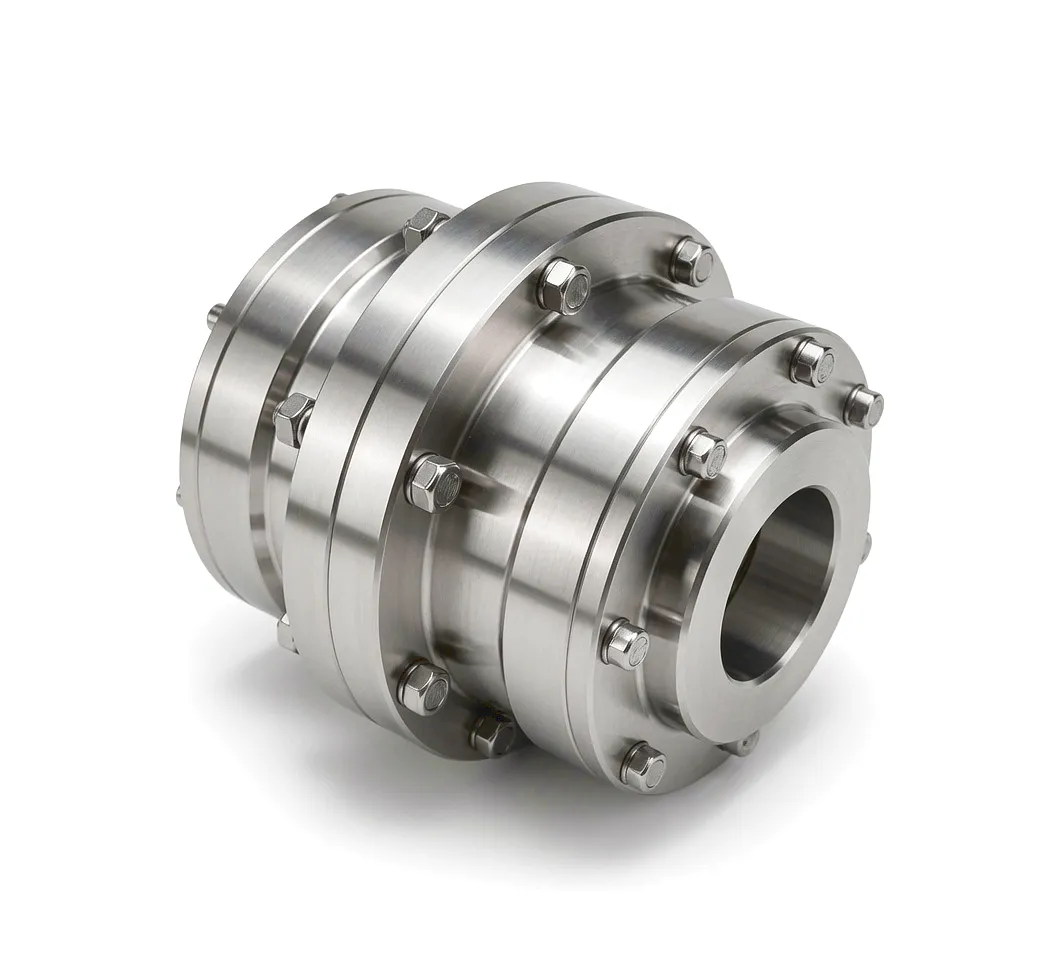 Walk the quayside at Felixstowe, Southampton, or London Gateway on any given weekday and the scale of a modern shore bridge — what the industry formally calls a ship-to-shore (STS) container crane — is immediately humbling. These steel giants can reach out 60 metres over a vessel’s beam, lift 65 tonnes of stacked boxes in a single cycle, and repeat that cycle 30 or more times an hour, 24 hours a day, for decades at a stretch. Somewhere inside every one of those machines, buried inside gearboxes and drive shafts that rarely make the maintenance roster until something goes wrong, sits a gear coupling. It is an unassuming component. It weighs a fraction of one per cent of the crane’s total mass. Yet a single coupling failure can halt a terminal berth, strand a 400-metre vessel at anchor, and cost an operator tens of thousands of pounds before the shift change.
This guide has been written from the perspective of an engineer who has spent 18-plus years specifying, installing, and troubleshooting gear couplings across heavy lifting and port-handling applications throughout the United Kingdom and beyond. The goal is not to sell you a part — it is to give you the technical depth to make an informed decision, understand the physics at work, and specify the right gear coupling for your shore bridge the first time.
What Makes Shore Bridge Cranes So Demanding on Mechanical Components?
Hoist Mechanism
The hoist (or lift) drive must accelerate, hold, and precisely lower loads between 40 and 65 tonnes. Motor powers typically range from 200 kW to over 600 kW per drive, with starting torques that can be three to five times the rated running torque. The coupling connecting the motor to the gearbox input shaft absorbs every one of those shock impulses — multiple times per cycle, hundreds of thousands of cycles over a maintenance interval.
Trolley Travel Mechanism
The trolley moves the spreader horizontally along the boom, covering up to 60 metres in a single pass at speeds reaching 180 m/min on modern fast-cycle cranes. The trolley drive gearbox output shafts run via gear couplings to the rope drums or rack-and-pinion drive wheels. Here angular misalignment is the primary challenge: thermal expansion of the boom structure can create several millimetres of shaft offset over an operating day.
Gantry (Long Travel) Mechanism
The entire crane body moves along the quay rail to reposition between vessel bays. Drive motors are typically distributed across multiple bogies — four to sixteen independent drive units on a large crane. Every bogie gearbox output requires a gear coupling that can tolerate rail irregularities, wind-induced structural flex, and the accumulated rail-joint impacts that add up over tens of kilometres of daily travel. Parallel misalignment is the dominant concern here, and it is relentless.
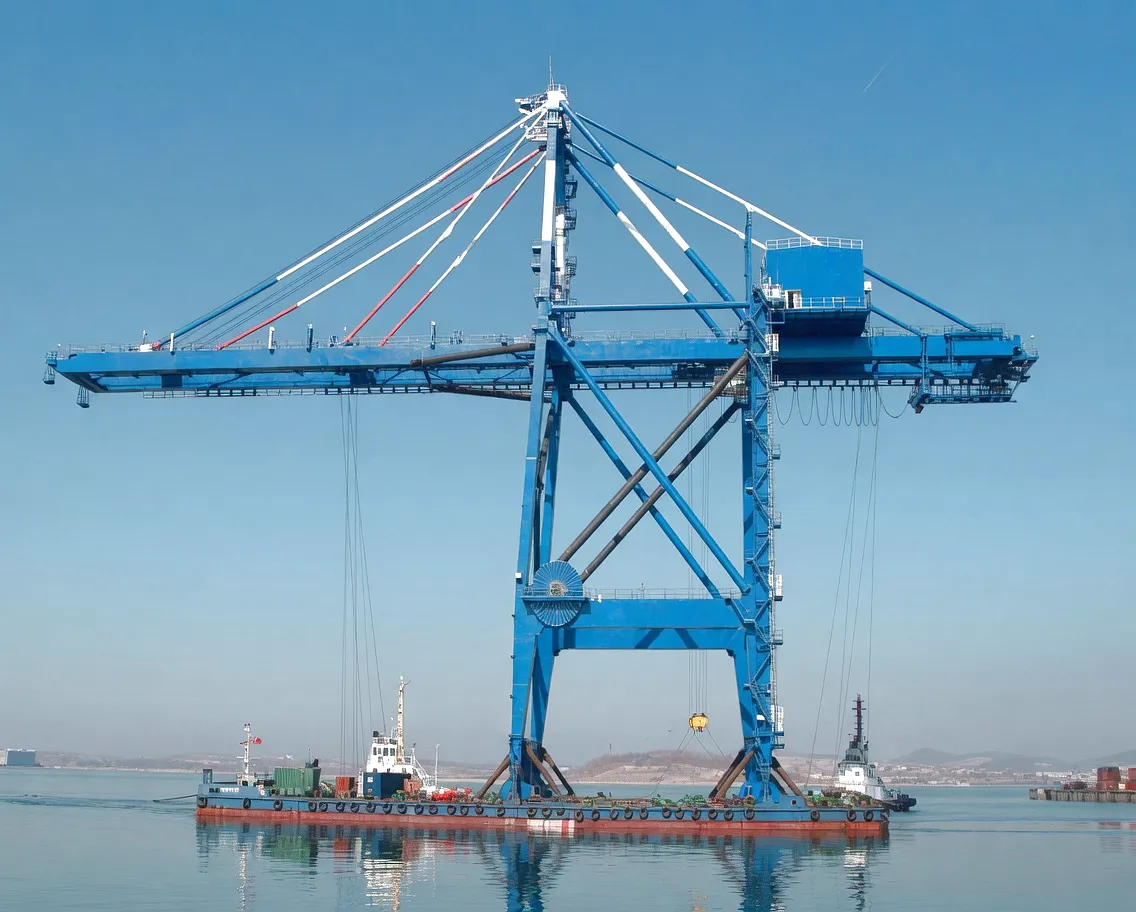 Beyond these three primary mechanisms, modern cranes integrate auxiliary winches for spreader rigging, boom-hoist systems for raising and lowering the outreach boom during vessel transit, and increasingly sophisticated anti-sway systems with their own servo-driven actuators. Every one of these sub-systems places additional demands on the couplings within its drive train. The aggregate picture is of a machine that cycles through a punishing combination of high torque, shock loading, thermal variation, structural flex, and 24/7 uptime requirements — an environment that quickly separates a properly specified gear coupling from a component that merely looks similar on a data sheet.
In the United Kingdom, where container terminals at Felixstowe, Southampton, Tilbury, and the Port of Liverpool operate under the added pressure of tidal windows and fixed vessel schedules, unplanned downtime carries costs that go far beyond the repair invoice. A reputable UK port engineering procurement manager once summarised it to this author with characteristic directness: “The coupling is a £1,500 part. The downtime is a £50,000 problem. We don’t spec on price — we spec on reliability.”s
How a Drum-Type Gear Coupling Works — Engineering Principles
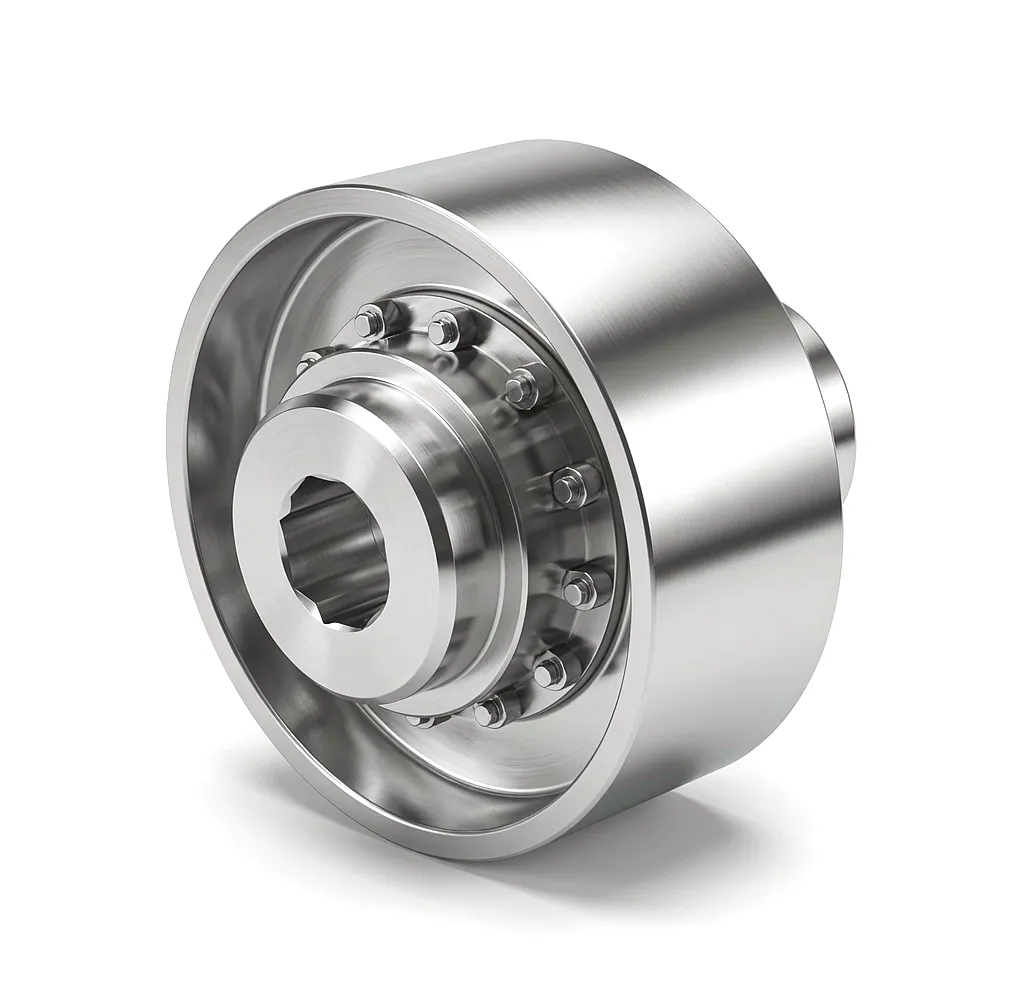 The dominant design used in shore bridge crane drives is the drum-type (or crowned-tooth) gear coupling, and understanding the physics of why it works helps appreciate why specification matters so much. At its core, a gear coupling transmits torque through meshing teeth: each hub has external teeth machined around its circumference, and each sleeve has matching internal teeth. The hub slides inside the sleeve, and when the shaft rotates, load passes through the contact area of those meshing teeth.
What distinguishes the drum type — and what makes it the preferred choice for crane drives — is the crowning on the external teeth. Rather than straight, parallel-sided teeth, the crowned design gives each tooth a slightly convex profile along its length. This crown allows the hub to tilt within the sleeve, accommodating angular misalignment of typically 1° to 2° per gear mesh without concentrating load at the tooth edges. A double-flex coupling (two gear meshes in series with a floating centre member) can accommodate parallel offset, angular misalignment, and axial displacement simultaneously.
The result is a mechanical joint that transmits full rated torque while the connected shafts are not in perfect alignment — a physical reality in every crane drive train, regardless of how carefully the initial installation was aligned. Thermal cycles, structural deflection under load, and foundation settlement ensure that alignment is a moving target throughout the coupling’s service life. The gear coupling accommodates this movement gracefully, without transmitting destructive reaction forces back into the motor bearings or gearbox output seals.
Materials Used in Shore Bridge Gear Couplings
Technical Performance Parameters
Reference data for GICL / NGCL drum-type gear couplings in crane-drive applications. Custom configurations available — see factory section below.
| Parameter | GICL-5 | GICL-8 | NGCL-10 | NGCL-16 | Custom Series |
|---|---|---|---|---|---|
| Nominal Torque (kN·m) | 5.0 | 8.0 | 10.0 | 16.0 | Up to 400+ |
| Max Speed (rpm) | 1,800 | 1,500 | 1,200 | 1,000 | Per design |
| Angular Misalignment (°) | 1.5 | 1.5 | 1.5 | 1.5 | Up to 2.5 |
| Parallel Offset (mm) | 0.25 | 0.30 | 0.35 | 0.40 | Per design |
| Axial Displacement (mm) | ±2.5 | ±3.0 | ±3.5 | ±4.0 | Up to ±15 |
| Bore Range (mm) | 45–80 | 60–110 | 75–130 | 90–160 | 20–500+ |
| Service Factor (KS) | 2.0–3.5 for crane drives (shock load class III) | Per application | |||
| Operating Temperature (°C) | –30 to +100 | –40 to +150 | |||
| Corrosion Protection | C4 standard; C5-M marine on request | C5-M standard | |||
* All ratings subject to final engineering verification. Consult Ever Power for application-specific sizing calculations including service factor, peak torque, and centre-distance requirements.
Why Drum-Type Gear Couplings Outperform Alternatives in Port Crane Service
1. Massive Torque Density
Gear couplings transmit higher torque per unit diameter than elastomeric or jaw-type alternatives. For a given shaft size, this translates directly to a smaller, lighter assembly — important in crane drives where every kilogram of rotating mass adds to the accelerating torque requirement and reduces effective payload capacity.
2. True Misalignment Accommodation
Unlike rigid couplings that transmit misalignment-induced bending moments directly to motor and gearbox bearings, drum-type gear couplings decouple the connected shafts from these lateral forces. For cranes operating in the UK coastal climate — where 15°C temperature swings in a single day are not unusual — this protection against thermally induced misalignment significantly extends bearing service life.
3. Infinite Torsional Stiffness
Steel-on-steel gear engagement provides essentially zero torsional deflection under load — a critical property for crane hoisting applications where positional control is paramount. An elastomeric coupling that winds up under peak torque introduces position error that the control system must correct, increasing cycle time and reducing precision during automated operation.
4. Long Inspection Intervals
Properly lubricated drum-type gear couplings in crane drives routinely achieve 20,000-hour inspection intervals when correctly selected and installed. For a UK port operating three shifts, that equates to more than eight years between planned coupling interventions — a significant contribution to overall crane availability and a reduction in the frequency of risky elevated maintenance work.
5. Robust Shock Load Handling
Shore bridge cranes subject couplings to repeated shock loading: the jolt when a hoist brake releases, the impact when trolley buffers are struck at overtravel, or the sudden load from wind gusting against the boom structure. Gear couplings, specified with an appropriate service factor, absorb and distribute these impulses without fatigue crack initiation — a failure mode that has caused catastrophic sudden-fracture events in underspecified elastomeric couplings on high-cycle crane duty.
6. Replaceability and Interchangeability
Ever Power’s standardised GICL and NGCL series are dimensionally interchangeable with the most widely used OEM specifications, meaning that UK terminal operators upgrading or replacing couplings on existing crane fleets can specify Ever Power components without modifying shaft, housing, or alignment geometry. Emergency repair kits can be stocked at terminal level, slashing response time from days to hours.
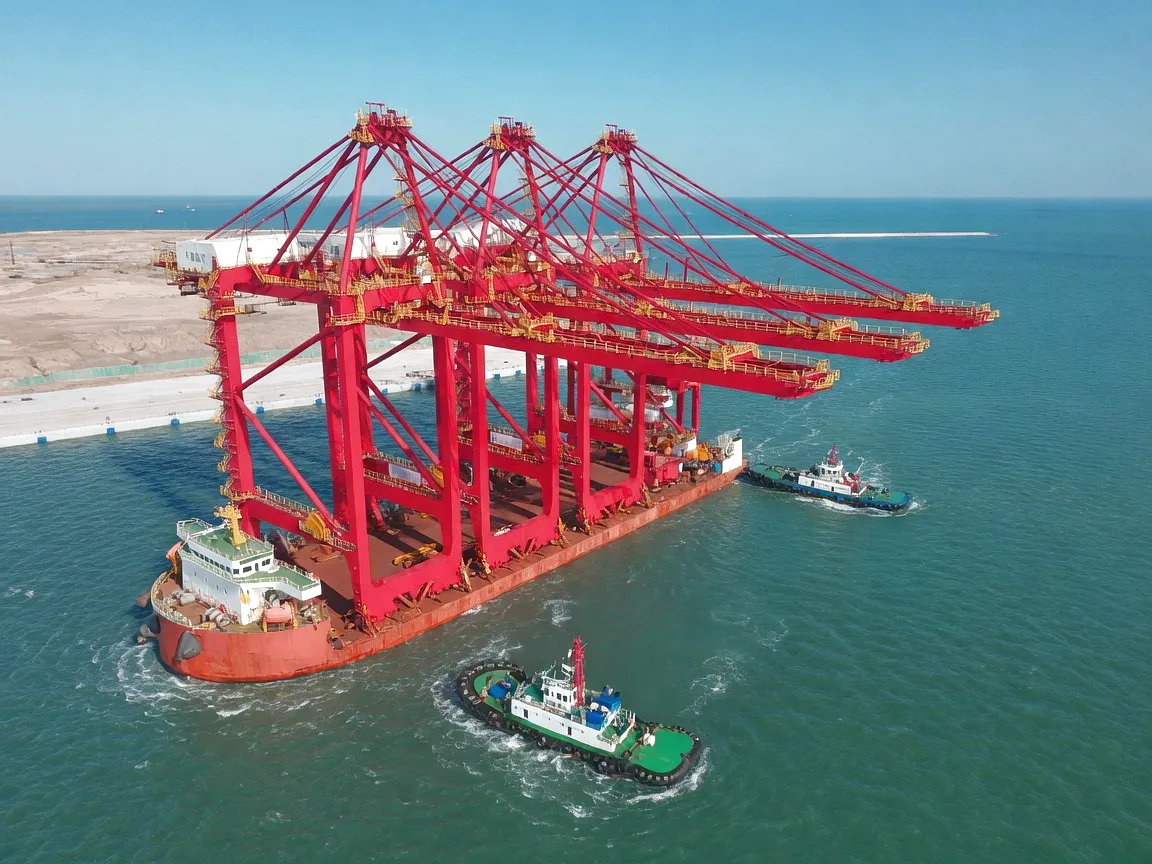
Real port crane drive installation — drum-type gear coupling in hoist drive train
Where Gear Couplings Are Used Inside a Shore Bridge Crane
Hoist Drive — Motor to Gearbox Input
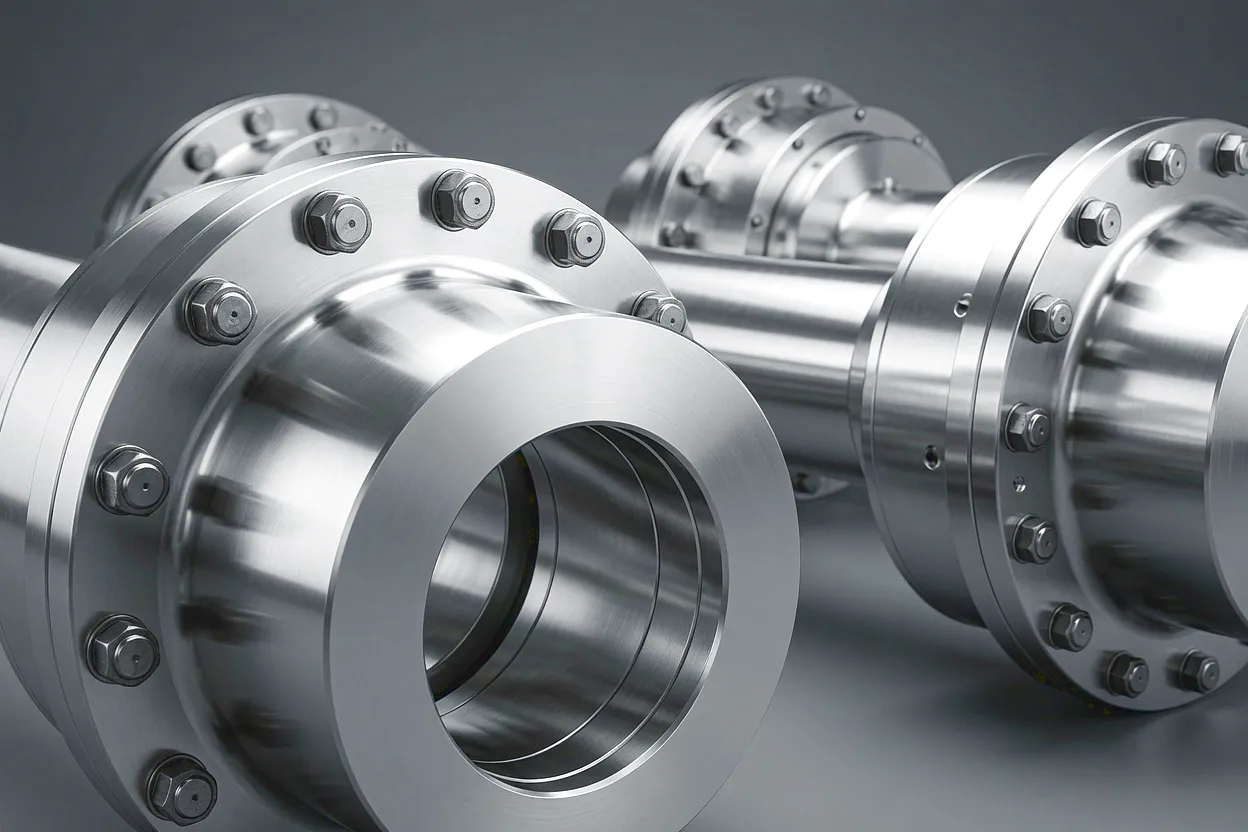 This is the highest-load coupling position in the entire crane. The hoist motor — frequently a 400 kW to 600 kW unit — drives the gearbox at 750 to 1,500 rpm. Starting currents produce peak shaft torques of two to five times the running value, and emergency stops introduce rapid reversal impulses. The gear coupling here must be sized for the peak torque multiplied by the crane’s service factor (typically 2.5–3.5 for hoist drives classified as shock load class III under ISO 8528). Crowned-tooth drum couplings from Ever Power’s GICL series with bore sizes between 80 mm and 160 mm cover the majority of crane hoist motor-gearbox interfaces found in UK port installations.
Angular misalignment tolerance is the secondary requirement here: the motor is often mounted on a sub-frame that flexes independently from the gearbox foundation, and thermal expansion differences between the motor casing and the steel sub-frame can create angular offsets of 0.3° to 0.8° in service. Without the crowned-tooth accommodation, this misalignment would concentrate stress at the inner bearing of the motor output shaft — a failure that typically manifests as vibration and premature bearing raceway pitting, months before the coupling itself shows visible distress.
Trolley Travel — Gearbox Output to Rope Drum
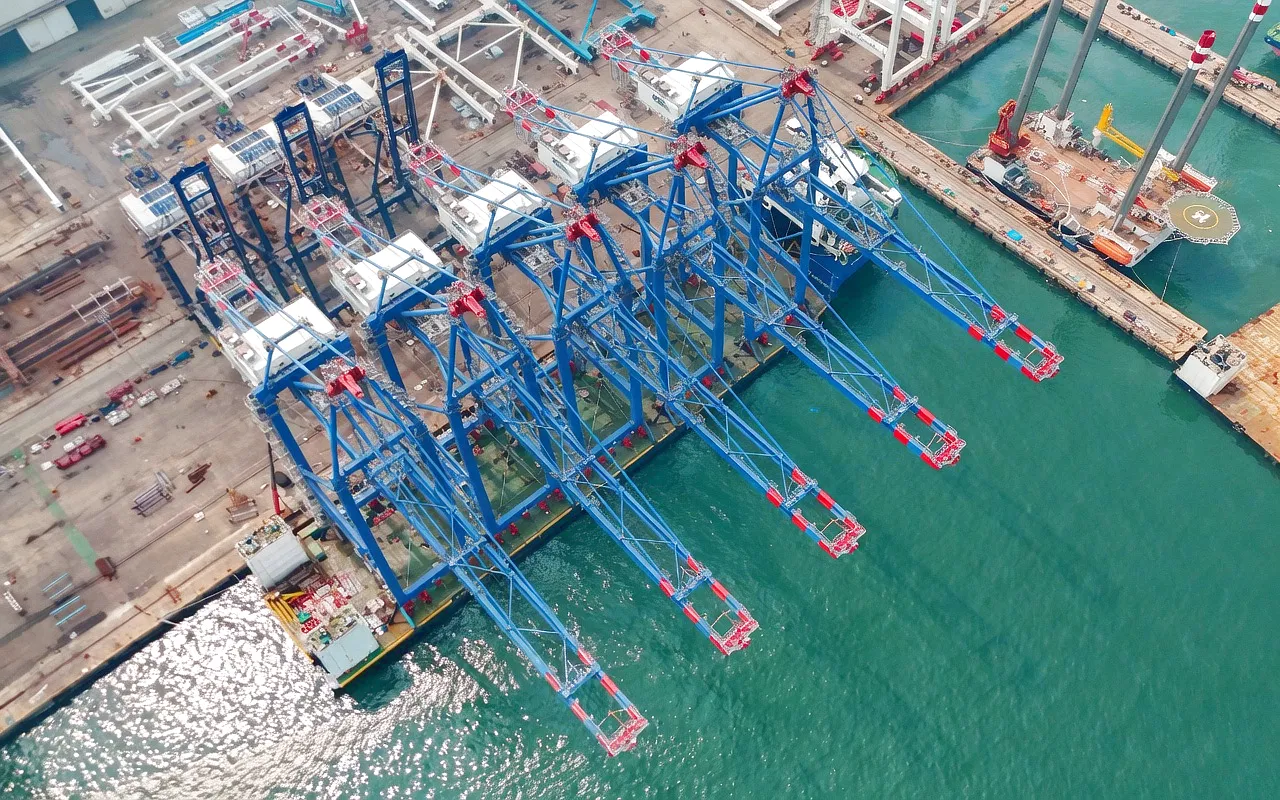 The trolley travel mechanism experiences the largest absolute misalignment values of any crane drive position. The boom structure that forms the rail for the trolley spans up to 60 metres, and under varying loads — from an empty spreader to a 65-tonne container — the deflection at midspan can exceed 80 mm. This structural movement creates continuous, dynamic misalignment at the coupling connecting the gearbox output to the rope drum drive shaft or the rack-and-pinion pinion shaft.
A double-flex NGCL gear coupling — two gear meshes in series with a spacer shaft — is the appropriate selection for this position. The spacer shaft length is calculated to ensure that the total angular misalignment at each gear mesh remains within the coupling’s rated capacity even under full boom deflection. Ever Power’s NGCL series is available with spacer shaft lengths from 100 mm to 1,200 mm, and the floating centre member can be supplied hollow to reduce rotational inertia on high-speed trolley drives.
Gantry Travel — Multi-Bogie Long Travel Drive
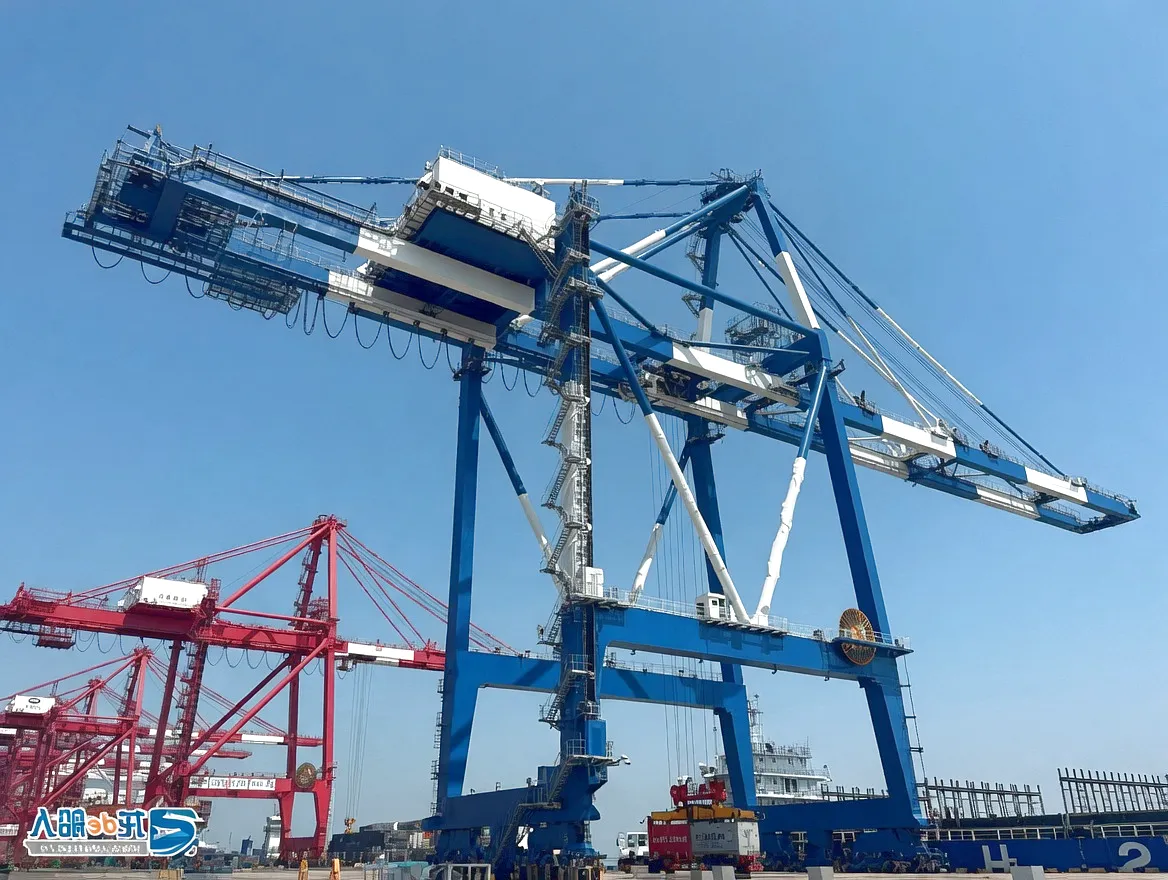 The long-travel (gantry) mechanism moves the entire crane along the quay. A large modern STS crane may weigh 1,500 tonnes and travel at speeds of up to 45 m/min. The rail surface at UK container ports — Felixstowe, Southampton, Tilbury, Teesport — inevitably includes minor settlement variations, joint gaps, and local deformation that introduce rail height differences of ±5 mm or more across adjacent bogie positions. These rail irregularities produce continuous angular and parallel misalignment impulses at every bogie gear coupling.
In this application, the gear coupling must also accommodate the axial float that arises as the crane structure experiences differential thermal growth between its landside and seaside legs — a particularly pronounced effect on UK port cranes, where the landside leg is often sheltered and the seaside leg faces prevailing westerly winds and salt spray. Marine-grade C5-M surface protection is mandatory for all gantry drive couplings, and Ever Power recommends stainless steel fasteners for all flange connections on quayside applications.
Ever Power Factory — Advanced Custom Gear Coupling Manufacturing
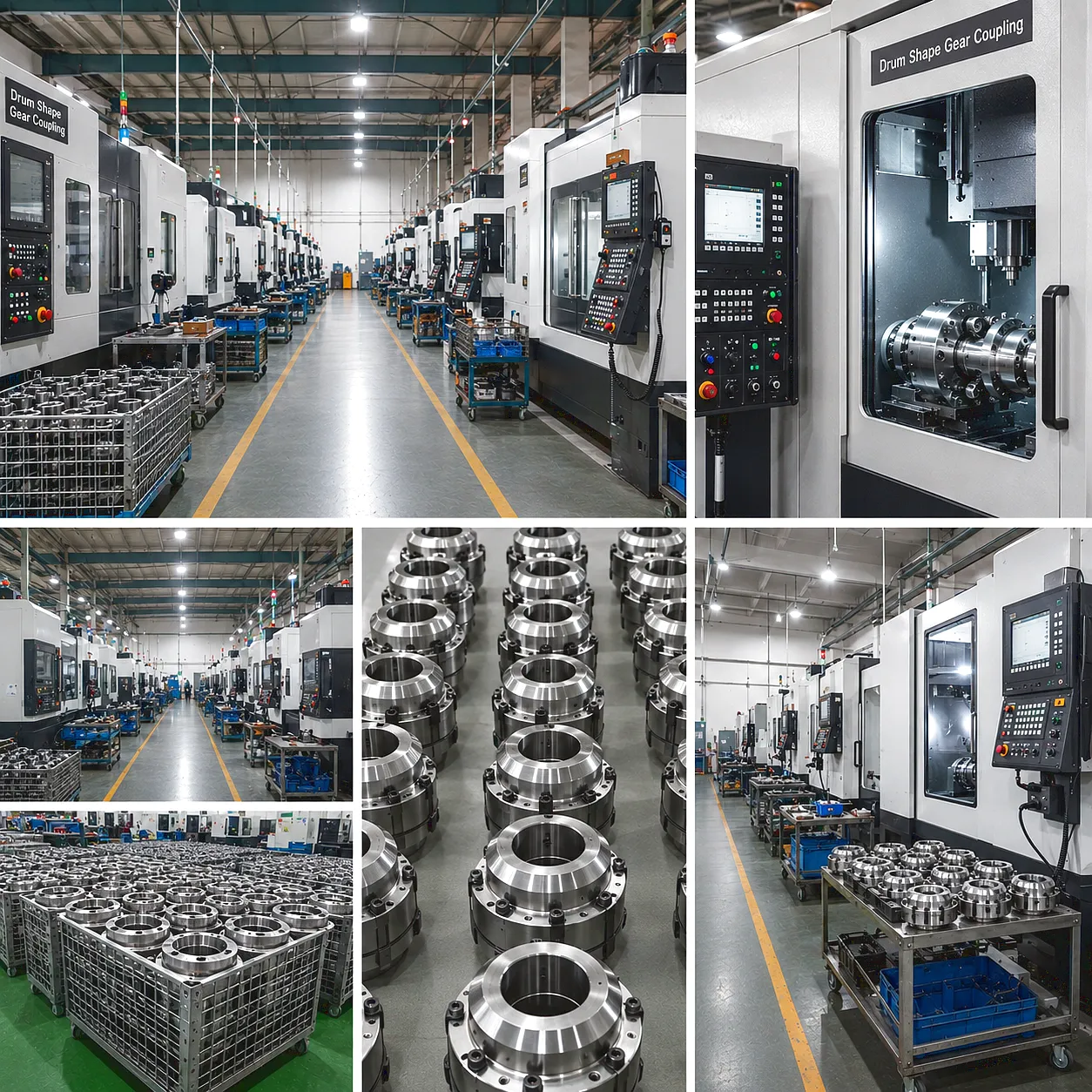
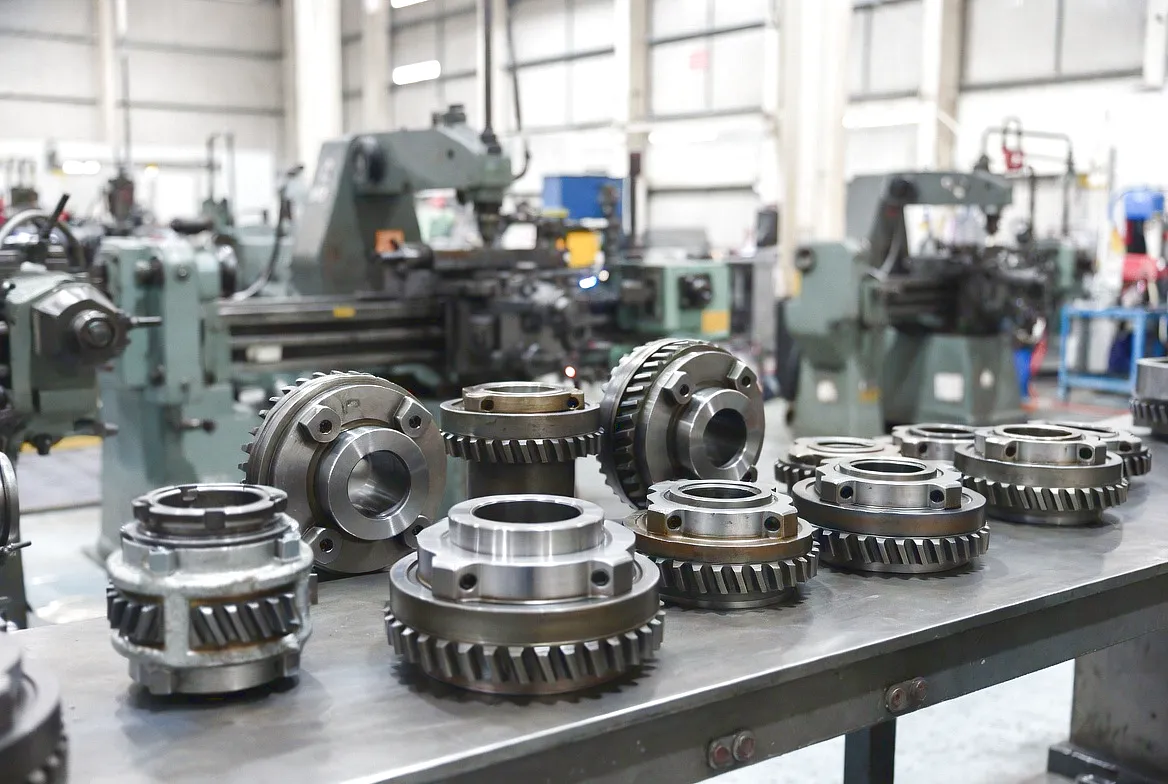
Ever Power’s manufacturing facility operates a comprehensive gear coupling customisation programme that goes far beyond simply offering different bore sizes. The engineering team — which includes specialists with direct experience on port crane, steel mill, and heavy lift applications — works from client-supplied drawings, OEM part numbers, or directly from dimensional survey data taken from the crane in situ. This means that UK terminal operators can replace obsolete or discontinued couplings on older crane fleets without undertaking costly shaft modification work.
The factory’s CNC gear grinding cells can produce crowned-tooth profiles to AGMA Class 11 / DIN 3960 Grade 6 tolerances, achieving tooth contact patterns that extend service life and reduce noise. The heat treatment line incorporates vacuum carburising for distortion-minimised case depths, followed by profile grinding to final tooth geometry — a process that eliminates the “softness” that can occur when conventionally heat-treated parts are left in the as-quenched-and-tempered condition.
Customer Success Story — Port of Felixstowe, United Kingdom
A documented case from one of the UK’s largest container terminals
A fleet of seven post-Panamax STS cranes, originally commissioned in 2004, began exhibiting recurring hoist gearbox bearing failures at intervals of 8,000 to 10,000 hours — roughly half the expected service life. Vibration analysis consistently pointed to misalignment-induced radial forces at the gearbox input bearing, yet the crane OEM’s alignment specification was being met at installation. The problem was traced to degraded couplings that had lost tooth crown accuracy due to manufacturing quality issues in the original supply chain, and were transmitting bending moments back into the gearbox rather than isolating them.
Ever Power supplied a matched set of GICL-10 hoist couplings manufactured to AGMA Class 11 tooth accuracy, with 42CrMo4 hubs, case-hardened to HRC 58–60 at the pitch circle. Marine C5-M coating was applied to all external surfaces, and the grease specification was upgraded to a lithium-complex compound with an ISO VG 460 base oil viscosity. A complete installation guide with torque values, alignment tolerances, and re-lubrication schedule was supplied as part of the delivery package.
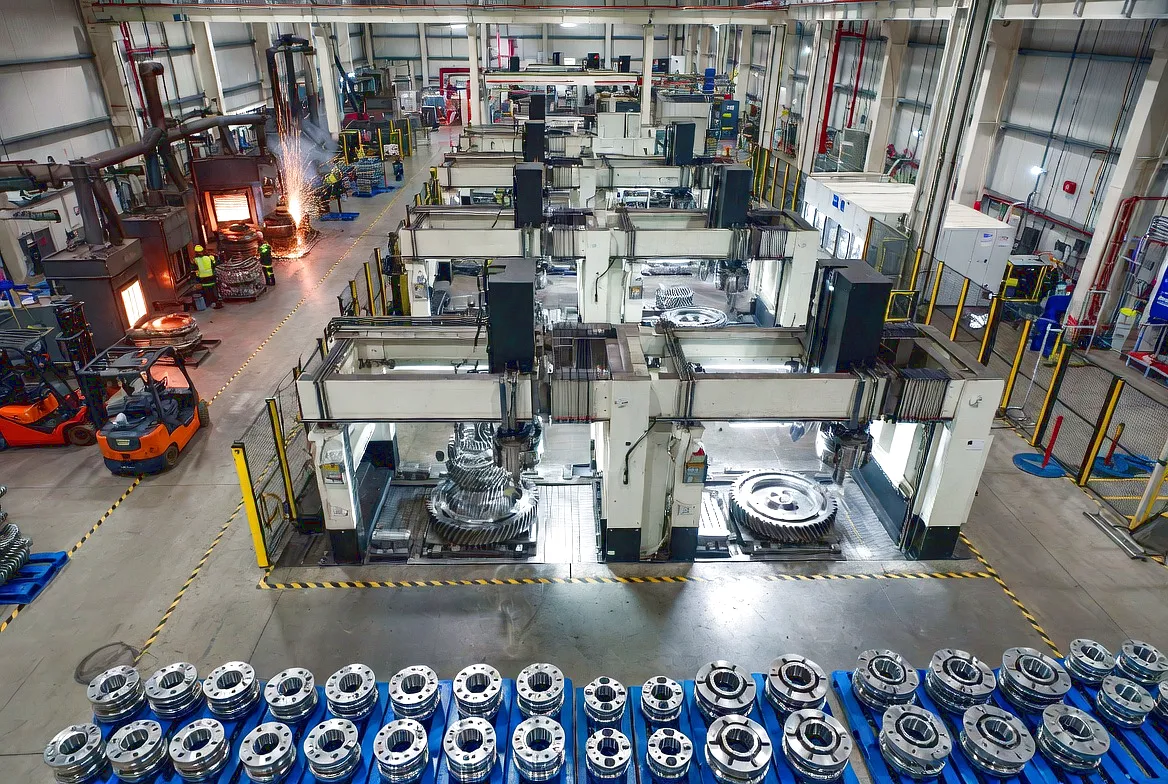
Ever Power quality-controlled gear couplings for port crane fleet replacement
What Our Customers Say
“We’ve been through three coupling suppliers over the past decade. Ever Power is the first one that came back to us after delivery to confirm the installation went correctly and ask for feedback. The couplings themselves have performed without a single issue across 14 months on our Liebherr hoist drives at Southampton.”
“We specified Ever Power NGCL couplings on gantry bogie replacements for six cranes at Tilbury in 2023. The delivery was on schedule, the dimensional accuracy was exceptional — every hub fitted without modification — and the documentation package was thorough enough to satisfy our DNV inspection requirements on the first submission.”
“We run ten STS cranes at Liverpool. When two hoist couplings required urgent replacement due to grease degradation during an unusually hot summer, Ever Power air-freighted exact-match replacements within 72 hours. The quality is reliably consistent batch to batch — something we struggled to achieve with our previous Asian supplier.”
Specifying the Right Gear Coupling for Your Shore Bridge — A Practical Checklist
Engineers specifying a gear coupling for a UK port crane replacement or new build need to work through a structured selection process. The decision tree is not complicated, but each data point is important. Skipping a step tends to result in either chronic under-specification (with the consequences already described) or costly over-specification that inflates the assembly weight and purchase price for no engineering benefit.
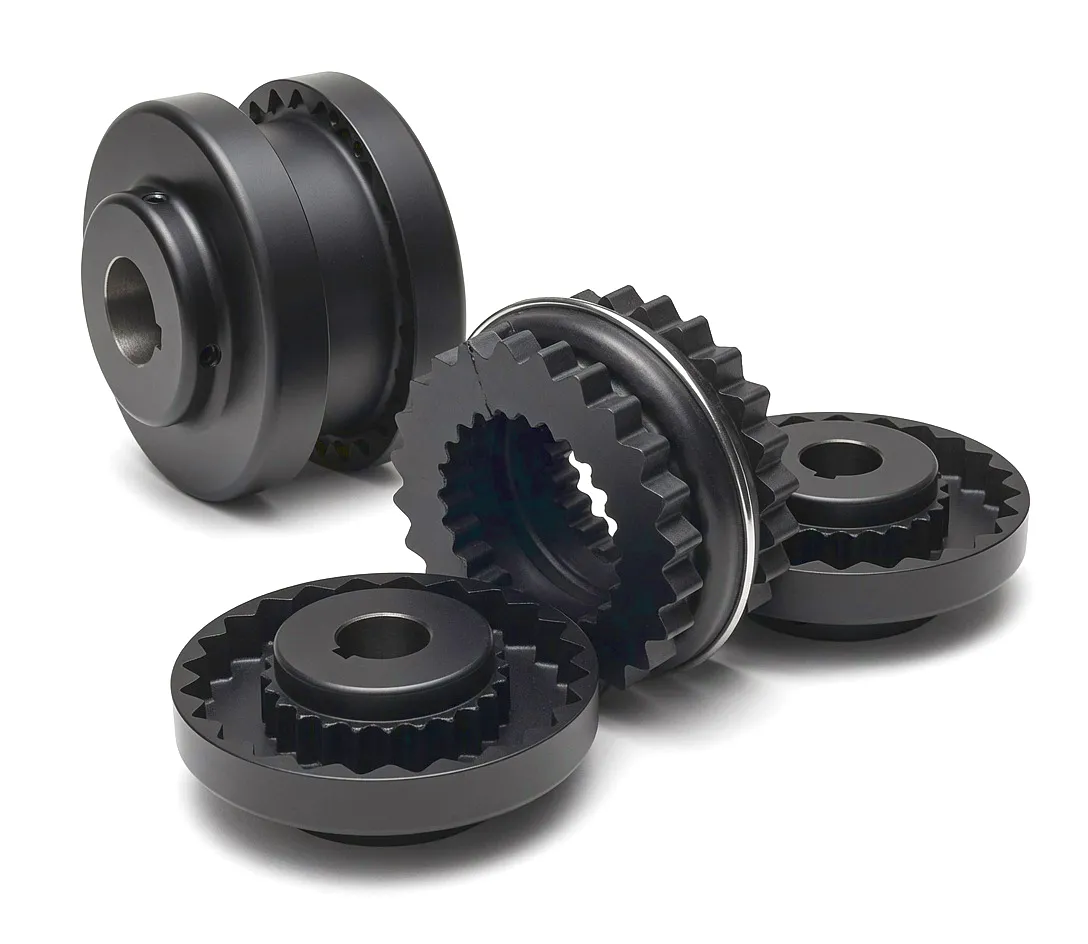
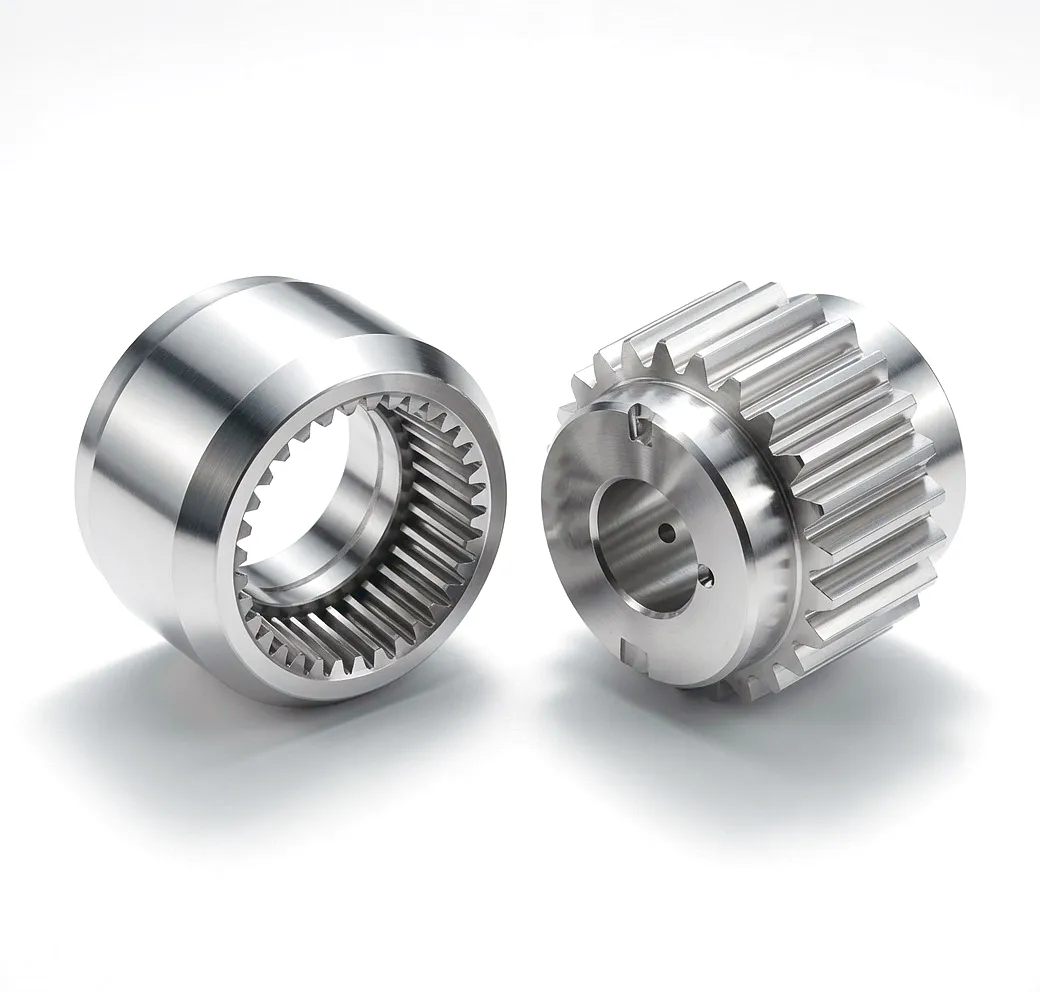
Ever Power product range: GICL, NGCL drum-type and NL nylon flexible coupling variants
Gear Coupling vs. Alternatives — Shore Bridge Application Comparison
| Criterion | Drum Gear Coupling | Elastomeric Jaw | Disc Pack | Rigid Flange |
|---|---|---|---|---|
| Torque Capacity | ★★★★★ Excellent | ★★★ Moderate | ★★★★ Good | ★★★★★ Excellent |
| Misalignment Tolerance | ★★★★★ Excellent | ★★★ Moderate | ★★★ Moderate | ★ Very Low |
| Shock Load Resistance | ★★★★★ Excellent | ★★★ Moderate | ★★★ Moderate | ★★★ Moderate |
| Service Life (crane duty) | 20,000+ hrs | 4,000–8,000 hrs | 8,000–15,000 hrs | N/A (bearing damage) |
| Maintenance Requirement | Low (regrease only) | Medium (element replace) | Low (no lubrication) | High (alignment critical) |
| Marine Corrosion Suitability | ★★★★★ C5-M rated | ★★★ Moderate | ★★★★ Good | ★★★ Moderate |
Frequently Asked Questions
Structured for voice search & long-tail discovery | FAQPage + Speakable Schema annotated below
Ready to Specify or Replace Your Shore Bridge Gear Coupling?
Send your requirements to Ever Power — bore sizes, torque rating, crane model, and port location — and receive a technical recommendation and price quotation within 48 hours.
Supplying gear couplings to port crane operators across Felixstowe, Southampton, Tilbury, Liverpool, Teesport and the wider United Kingdom