The FARR Coupling is utilized whenever a rigid connection is needed involving the low speed shaft of the gearbox and also the head shaft of a conveyor, bucket elevator, mixer or any over-hung or suspended load. When sized appropriately, the FARR Coupling will carry the applica-tion torque, excess weight of gearbox, motor and swing plate. From the case of a mixer, it’s going to carry the excess weight on the shaft and impeller, thrust forces and resulting bending moments.
Components 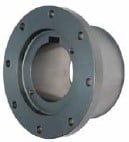 of the FARR Coupling consist of male and female piloted hubs produced from 4140 alloy steel. The hubs are extended to assure 80% hub to shaft get in touch with. Keeper plates are integrated for security. The 2 hubs are assembled with Grade eight bolts and Grade À Prevailing Torque nuts. Regular coupling sizes have a nominal torque range from 11,300 to 5,736,000 in-lbs. More substantial sizes can be found based upon the application.
Characteristics
Heat Treated 4140 alloy steel
Male and Female pilots
Enhanced Torque Capacity
Grade 8 Bolts / Grade ?¡ãC?¡À Prevailing Torque Nuts
Extended length via bore
Keeper Plate design
FARR Coupling Variety Guide
A. Obtain The next Details:
Application
Horsepower & RPM
Gearbox (Reducer) Ratio
Output Speed
All Shaft Sizes
Overhang Load
Lever Arm
(Distance from end of Gearbox output Shaft to Center-Line of Gearbox or Center Line of Gravity)
B.Calculate Application Torque:
T (in-lb) = ¡ê¡§HP x 63025¡ê?/RPM
C.Calculate Design Torque by applying 2.0 Service Factor to application torque.
D.Select coupling with a torque capacity equal to or greater than the Style Torque from the Performance Data table.
E.Verify that the Bore capacity in the coupling will meet the application shaft requirements.
F.The Male pilot hub to always be utilised around the Reducer (Gearbox or Driver) shaft and also the Female pilot hub to always be used to the Head (Driven) shaft.
G.Drive System Analysis must be performed by Application Engineering to verify coupling choice.